


Roth conversions in retirement and the temporary window many retirees never realize they might have.
We are well into what I like to call the “information era of investing.” Social media and artificial intelligence now offer basic financial education to everyone, and that is a great development. Still, basic education often opens the door to more complex questions, and those are the ones that tend to land on my desk.
Today we’ll look at Roth conversions for retired investors, one of the topics I’m asked about most often, by clients at every level of wealth. Most people have heard of them, yet many still can’t answer the real question: “Would this benefit my situation?” I keep having the same conversation with recently retired clients, so I want to shed light on a special window that many Americans pass through without realizing what is at stake. Used well, Roth conversions can help reduce lifetime taxes for some retirees.
The short version • Early in retirement, many people have a few unusually low-income years. I call this the Tax Valley. • A Roth conversion lets you move savings out of a pre-tax IRA during those years, paying tax at potentially lower rates than you may face later. • The skill is in how much to convert: enough to use the low brackets, not so much that you trigger higher rates or higher Medicare premiums. |
How a Roth Conversion Works
In simple terms, a Roth conversion moves money from a Traditional IRA (or 401(k)) into a Roth IRA. Here is the trade:
- You pay: ordinary income tax on the amount converted, in the year you convert it.
- You may receive: the potential for tax-free growth and tax-free qualified withdrawals (generally after age 59½, once the Roth has been open five years).1
- It works best when you expect a similar or higher tax rate later, or you want to shrink the withdrawals the IRS will eventually require from your pre-tax accounts, called Required Minimum Distributions (RMDs). It also helps to be able to pay the tax from savings outside the IRA.
The goal is not to avoid taxes, but to control when you pay them.
Understanding the Tax Valley1
Between retirement and the start of RMDs (at 73 or 75, depending on the year you were born)2, many retirees pass through a temporary dip in taxable income. The paychecks have stopped, Social Security often hasn’t been claimed yet, and RMDs aren’t forcing withdrawals yet. This stretch of years is what I call “The Tax Valley.”
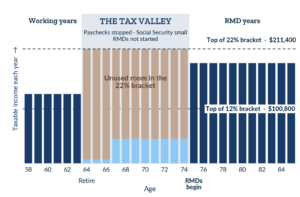
Illustrative only. The chart shows the general shape of taxable income across retirement, not a projection for any individual. The shaded area is room in the 22% bracket that goes unused each year of the valley. Not all retirees will experience unused room in the 22% bracket. The shape and depth of the valley depend on individual income sources, filing status, and applicable deductions.
| The Tax Valley can be a limited window to convert pre-tax savings to a Roth at rates that may be lower than in the working years before it or the RMD years after it. |
Why the window can close
For many retirees, this window narrows or closes once RMDs begin. At that point, the IRS requires taxable withdrawals whether you need the income or not. Stacked on top of Social Security and other income, those withdrawals can push retirees back up the tax bracket ladder. The Tax Valley is your chance to potentially “fill up” the lower brackets on purpose, before RMDs begin filling those brackets automatically.
What it can offer
- Potential tax-free dollars for a large, unexpected expense, such as a medical bill
- Smaller RMDs later, which can help you avoid a high bracket after RMD age
- Lower odds of Medicare surcharges, since high income in retirement can raise premiums
- A potential tax reduction for a surviving spouse, who will file with single brackets
- A Roth that heirs can inherit income-tax-free (most non-spouse heirs must empty it within 10 years)3
The Balancing Act
No one argues with the benefits of tax-free savings, but converting in your own Tax Valley is not always simple. There is a real tension between converting too little and converting too much.
- Too little: the opportunity is wasted, and your RMDs later in life are nearly as large as they would have been without the conversion.
- Too much: you spill into a higher bracket right away, or cross a threshold that carries its own cost.
Each conversion should be measured against these four limits:
| Limit | What happens if you cross it |
| Top of your target tax bracket | The extra conversion is taxed at a higher rate. |
Medicare IRMAA threshold ($218,000 joint income)4 | Medicare Part B and Part D premiums rise. IRMAA is based on your income from two years earlier5, so a conversion today affects premiums two years from now, and conversions must account for these cliffs across multiple years. Thresholds are adjusted for inflation each year. |
ACA subsidy cliff (about $84,600 for a couple in 2026)6,7 | Marketplace premium subsidies disappear. This matters if you buy your own coverage before 65. The cutoff is reset each year and depends on current law. |
| Social Security taxation | Once benefits start, more of your benefit becomes taxable. |
For many retirees, the sweet spot is converting just enough to fill an acceptable bracket (commonly the 12% or 22% federal bracket) without crossing into the next one or over the IRMAA line. For retirees with larger pre-tax balances, that usually means stopping at the first IRMAA threshold, which typically comes before the top of the 22% bracket.
Example: Tom and Linda
Let’s walk through the math with Tom and Linda, a married couple who are both 64 and recently retired. They haven’t claimed Social Security, and their only other income is about $40,000 a year from a pension and interest. Their health coverage comes from a former employer’s retiree plan, so ACA subsidies are not a factor for them. For simplicity, the examples use the same $32,200 standard deduction every year, although once they turn 65 they would qualify for additional senior deductions.8 We’ll look at them twice: first with a modest IRA to learn the basics, then with a larger one.
Start simple: a $900,000 IRA
Step 1: Find their taxable income. After subtracting the 2026 standard deduction for married couples ($32,200)9, their taxable income is just $7,800.
Step 2: Find the room in their bracket. For 2026, the 12% federal bracket for married couples tops out at $100,800 of taxable income9. That leaves $93,000 of room before they reach the 22% bracket.
Step 3: Convert to fill the valley. If they convert $93,000, they would owe roughly $10,820 in federal tax, an average of about 11.6% on the converted dollars. Their total income of about $133,000 also stays well below the first IRMAA threshold ($218,000 for joint filers in 2026)4, which matters because this year’s income will set their Medicare premiums at age 66.5 (The threshold shown is the 2026 figure. The one that applies in two years will be adjusted for inflation.)
Step 4: Compare it to later. Now fast forward to age 75. With Social Security, the pension, and RMDs from a larger, untouched IRA all stacked together, those same dollars could easily be taxed at 22% or more.
| By converting in the valley, Tom and Linda would pay about 12 cents on the dollar today, compared with the 22 cents or more they could face later. Repeated over several years, that difference could add up, depending on future tax rates and income. |
Hypothetical illustration only. Future tax rates, tax law, and personal circumstances may differ. Actual future tax rates are uncertain and may be higher or lower than current rates. This example illustrates potential tax outcomes only and does not represent investment performance of any CWA portfolio or strategy
Now a larger balance: a $2,300,000 IRA
With a much larger IRA, there is far more to move than the 12% bracket can hold, so the 22% bracket comes into play. But more room is not a license to convert it all.
Step 1: Find the stopping point. The 22% bracket ends at $211,400 of taxable income9, which would leave $203,600 of room. But the first IRMAA threshold ($218,000 of total income)4 sits lower. Once you subtract the $32,200 deduction1, that is only $185,800 of taxable income.
Step 2: Convert up to the line. They convert $178,000, which brings taxable income to $185,800 and keeps total income right at the threshold. That costs about $29,520 in federal tax, an average of 16.6%.
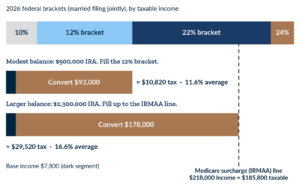
Simplified and hypothetical, using 2026 federal figures. Dark segment is the $7,800 of base taxable income.
Step 3: See what it does later. Left untouched, their IRA could reach about $4.4 million by 75 (assuming an illustrative 6% annual growth rate), with a first RMD near $177,000. That could put them in the upper part of the 22% bracket, over the first IRMAA threshold within the first RMD year, and into the 24% bracket by their mid 80s, or sooner if one spouse passes away and the survivor must file as a single individual.
Converting up to the IRMAA line for just the three years before Social Security would cut that first RMD to about $137,000. In this hypothetical, they would also remain in the 22% bracket and under the first IRMAA threshold through age 85.
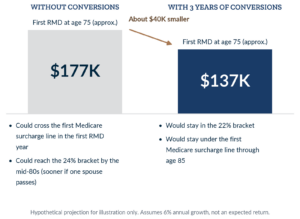
Hypothetical projection for illustration only, using the $2,300,000 IRA case and an assumed 6% annual growth rate that is not an expected return. Actual results will differ.
These examples are simplified and hypothetical, using 2026 federal tax figures. They do not include state taxes or the additional deductions available to those 65 and older, and every situation is different, so be sure to speak with a tax professional before making any decisions. This example illustrates potential tax outcomes only and does not represent investment performance of any CWA portfolio or strategy.
Is It Right for You?
Roth conversions can be a major driver of lifetime tax savings, but they do not work for everyone.
| Roth conversions tend to fit if you have… | They make less sense if you… |
| Large pre-tax balances | Expect a lower tax bracket later |
| Several low-income years before Social Security and RMDs | Rely on ACA subsidies |
| Cash outside the IRA to pay the tax | Plan to leave your IRA to charity |
The right answer depends on your full picture, so work through it with your financial advisor and tax professional to determine the appropriate strategies for you.
SOURCES
- IRS, Publication 590-B: Distributions from IRAs (Roth IRA qualified distribution rules)
- Federal Register, Required Minimum Distributions; Final Rule (July 19, 2024) (RMD ages of 73 and 75)
- IRS, Retirement plan and IRA required minimum distributions FAQs (no lifetime RMDs for Roth IRAs, and the 10-year rule for most heirs)
- CMS, 2026 Medicare Parts A & B Premiums and Deductibles (IRMAA income thresholds)
- gov, 2026 Medicare costs fact sheet (IRMAA is based on income from two years earlier)
- HHS (ASPE), Poverty guidelines (2025 guidelines used to set the 2026 ACA subsidy cutoff)
- IRS, How Your Income Affects Your Premium Tax Credit (100% to 400% of the federal poverty line eligibility range)
- IRS, Publication 6142: Additional Deduction for Seniors (senior deduction and its income phase-out)
- IRS, IRS releases tax inflation adjustments for tax year 2026 (2026 standard deduction and tax brackets)