
The world is deglobalizing — and we’re not fighting it. We’re embracing it.
Deglobalization Isn’t New — It’s Accelerating
Our framework starts with a simple observation: the world has been deglobalizing since 2016. Brexit — Britain’s vote to leave the European Union — was the first real countertrend move against the globalization wave that began at the end of World War II. That was the crack in the dam.
Since then, the cracks have only widened. Covid shattered supply chains in ways we’re still reckoning with. Russia’s invasion of Ukraine fractured energy markets and geopolitical alliances. And now, the current conflict involving Iran has closed the Strait of Hormuz, through which roughly 20 million barrels of crude oil flow every single day.
This isn’t a one-off disruption. It’s a trend. And once you see it as a trend, you stop being surprised by it and start positioning for it.
The Strait of Hormuz: A $2 Billion-a-Day Prize
Let’s do the math. Twenty million barrels a day at $100 a barrel — that’s $2 billion in value passing through a single maritime choke point every day.
Now think about that through the lens of a crime caper. How many desperate actors around the world would risk a great deal extorting even a fraction of $2 billion a day? The answer, unfortunately, is plenty.
That’s exactly what’s playing out. And this isn’t even the first time we’ve seen it recently. Just a few years ago, the Houthis in Yemen — an Iranian-backed faction — began constricting the flow of ships through the Red Sea and the Suez Canal. That was instructive. It showed us what happens when even a relatively small group can grab hold of a critical choke point and squeeze.
Choke Points Are the Story of Deglobalization
The concept of the choke point is central to understanding where the world is headed. In the old, globalized order — the one underwritten by American hegemony and secured by the U.S. Navy — these shipping lanes and straits were kept open. Pirates and would-be extortionists were held at bay.
But as the great power competition between the U.S. and its allies on one side and China and its allies on the other intensifies, that security regime is fracturing. Smaller fringe groups are now able to exploit the gaps, seizing choke points and leveraging them for outsized influence.
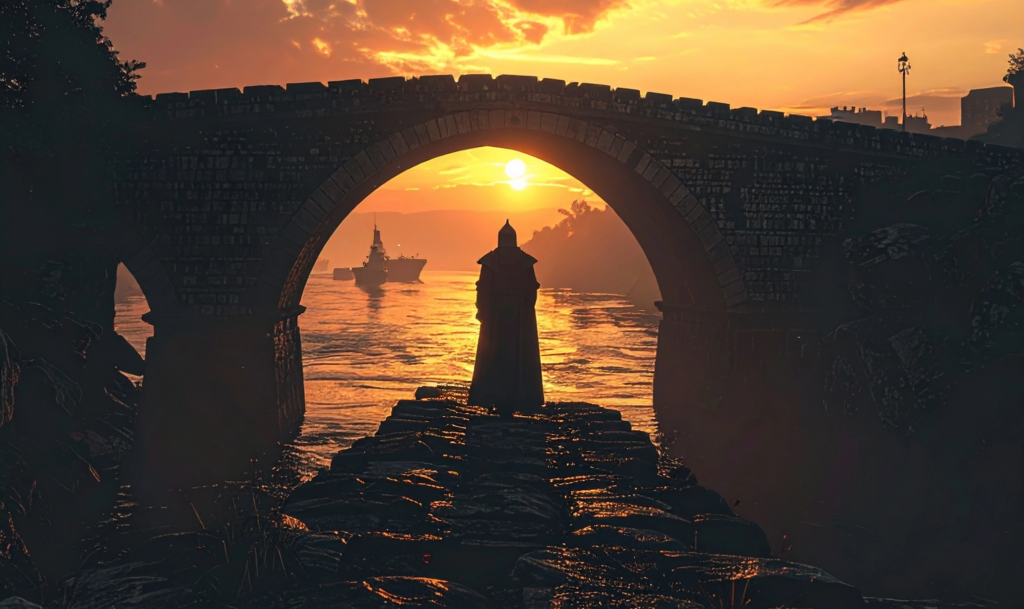
If you want a historical parallel, think of an overly simplistic example from the European Dark Ages. Every river had a bridge, and every bridge had some knight demanding a toll before you could cross. Commerce was expensive, movement was dangerous, and the secure thing to do was to make everything locally. That’s where feudal society came from — the lord of the manor sourcing everything he needed from right there on his own land, because the cost and risk of moving goods was simply too high and unreliable.
We’re not headed back to the Dark Ages. But we are moving toward a world where the free flow of goods and capital that we took for granted is no longer guaranteed.
Why We’re Aggressively Positioned in Energy
So, what does this mean for investors? It means we are very aggressively invested in higher energy prices and further global disruption.
I’ve said before that energy is like the oxygen of the global economy — you can’t live two minutes without it. And yet the market, in my view, still isn’t putting the right premium on the future delivery of crude oil given the magnitude of disruption risk we’re seeing.
The Strait of Hormuz situation is the second major choke point disruption in just the last couple of years. There will be more. That’s not fear-mongering — it’s the logical extension of the deglobalization trend we’ve been tracking since 2016.
Believe the Change
My biggest strategic view right now is simple: believe the change.
Don’t fight the trend. Don’t assume things will snap back to normal. The formerly free-trade, free-flow-of-capital world that we enjoyed for decades is giving way to something that looks fundamentally different. Every one of these choke point disruptions is another step in that direction.
It’s going to be an interesting time in the markets. For those willing to see the trend for what it is and act accordingly, I think it’s a remarkable opportunity.
Remember that the job of the market is to find and reward companies that create solutions that society needs. As those needs change, it’s only natural that new companies making new solutions rise from obscurity to prominence. Those are the opportunities we are looking for.